
Law Firm Chart of Accounts Sample: A Guide for Small Law Firms
Feb 28, 2026Managing the financial side of a law firm requires more than standard bookkeeping. Legal practices must carefully track client funds, operating expenses, revenue, payroll, and trust accounts while maintaining compliance with strict accounting and ethical requirements.
One of the most important foundations of proper legal bookkeeping is a well-structured chart of accounts. Without it, financial reporting can become disorganized, trust accounting errors may occur, and important business decisions become harder to make.
For small law firms, creating a clean and organized chart of accounts helps improve visibility, streamline bookkeeping, and support long-term growth.
What Is a Law Firm Chart of Accounts?
A chart of accounts is a structured list of all financial accounts used by a business to organize transactions. It acts as the framework for a company’s bookkeeping and accounting system.
Every transaction in a law firm—whether it involves revenue, payroll, software expenses, trust funds, or operating costs—is categorized into an account within the chart of accounts.
These accounts are generally grouped into five primary categories:
- Assets
- Liabilities
- Equity
- Revenue
- Expenses
For law firms, the chart of accounts must also account for legal-specific financial requirements like IOLTA trust accounts and client retainers.
Why Law Firms Need a Specialized Chart of Accounts
Law firms operate differently than many other small businesses. Attorneys often hold client funds in trust, bill based on retainers or hourly work, and must maintain detailed financial records for compliance purposes.
A generic bookkeeping setup may not properly separate operating funds from client trust funds, which can create serious accounting and ethical problems.
A properly designed law firm chart of accounts helps firms:
- Maintain trust accounting compliance
- Improve financial reporting accuracy
- Simplify tax preparation
- Track profitability
- Monitor cash flow
- Reduce bookkeeping errors
- Support cleaner QuickBooks organization
Small law firms especially benefit from a structured accounting system because it helps create consistency as the firm grows.
Sample Law Firm Chart of Accounts
Every law firm is different, but most firms use a similar core structure for organizing financial accounts.
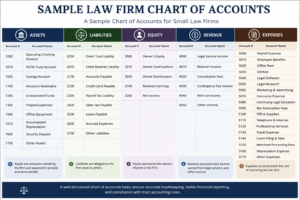
Here is a simplified sample law firm chart of accounts:
Assets
- Operating Checking Account
- IOLTA Trust Account
- Savings Account
- Accounts Receivable
- Undeposited Funds
- Office Equipment
- Computers and Technology
Liabilities
- Client Trust Liability
- Credit Card Payable
- Payroll Tax Liability
- Loans Payable
- Sales Tax Payable
Revenue
- Legal Service Income
- Retainer Income
- Consultation Fees
- Contingency Fee Income
- Referral Income
Expenses
- Payroll Expense
- Rent
- Legal Research Software
- Marketing and Advertising
- Insurance
- Bar Association Fees
- Continuing Legal Education
- Office Supplies
- Telephone and Internet
- Professional Services
- Merchant Processing Fees
This structure gives small law firms a cleaner financial overview while supporting proper bookkeeping practices.
Common Law Firm Asset Accounts
Asset accounts track what the law firm owns or controls financially.
For law firms, some of the most important asset accounts include operating bank accounts, trust accounts, accounts receivable, and fixed assets like office equipment.
The IOLTA or client trust account is especially important because these funds do not belong to the law firm. They must remain carefully separated from operational funds and tracked accurately at all times.
Other asset accounts may include prepaid expenses, security deposits, or case-related advanced costs.
Common Law Firm Liability Accounts
Liability accounts track money the firm owes to others.
One of the most critical liability accounts for a law firm is the client trust liability account. This account represents money being held on behalf of clients and should match the balance of the trust bank account.
Additional liability accounts often include payroll taxes owed, business loans, and outstanding credit card balances.
Proper liability tracking helps firms avoid cash flow issues and maintain accurate financial reporting.
Revenue Accounts for Law Firms
Revenue accounts help law firms separate and track different sources of income.
Depending on the type of law practice, firms may generate income from hourly billing, retainers, flat fees, contingency fees, or consultations.
Separating revenue into different categories allows attorneys to better understand which services generate the most income and profitability.
For example, a law firm may discover that certain practice areas consistently outperform others financially. Organized reporting makes these insights easier to identify.
Law Firm Expense Categories
Law firms have a wide range of recurring operational expenses that should be categorized properly within the chart of accounts.
Some of the most common expense categories include:
- Payroll and employee benefits
- Office rent and utilities
- Case management software
- Legal research subscriptions
- Marketing and SEO services
- Continuing legal education
- Professional insurance
- Court filing costs
- Travel expenses
- Technology and IT support
Well-organized expense tracking helps law firms understand where money is being spent and identify opportunities to improve profitability.
Why Trust and IOLTA Accounts Need Special Attention
Trust accounting is one of the most important parts of legal bookkeeping. Law firms are ethically and legally required to manage client funds carefully and transparently.
Improper handling of trust funds can lead to audits, penalties, or disciplinary action.
That is why trust accounts should always have separate ledger tracking, monthly reconciliations, and clearly defined accounting procedures.
A properly structured chart of accounts helps ensure that trust transactions remain separate from operating transactions and that client balances are accurately maintained.
For many small law firms, outsourced bookkeeping support can help reduce trust accounting risks significantly.
How a Clean Chart of Accounts Improves Financial Reporting
Accurate financial reporting starts with proper account organization.
When transactions are categorized correctly, law firms can generate cleaner profit and loss statements, balance sheets, cash flow reports, and tax documentation.
This improves visibility into:
- Monthly profitability
- Operating expenses
- Outstanding receivables
- Cash flow trends
- Trust account balances
- Growth opportunities
Without a properly structured chart of accounts, financial reports can quickly become confusing or misleading.
Good reporting allows law firm owners to make more informed decisions about hiring, marketing, budgeting, and future expansion.
When to Get Help Setting Up Your Law Firm Accounting
Many small law firms start with basic bookkeeping setups that eventually become difficult to manage as the practice grows.
If financial reports are disorganized, trust accounting feels overwhelming, or QuickBooks categories no longer make sense, it may be time to work with a professional bookkeeping or accounting service that understands legal accounting.
An experienced accounting professional can help create a customized chart of accounts, clean up existing records, improve reporting accuracy, and support long-term financial organization.
For small law firms, having the right accounting structure in place creates a stronger operational foundation and helps reduce unnecessary financial stress.
Final Thoughts
A properly organized law firm chart of accounts is essential for maintaining accurate bookkeeping, improving financial reporting, and supporting trust accounting compliance.
For small law firms, the right accounting structure helps create clarity, reduce errors, and improve day-to-day financial management. Whether managing payroll, tracking expenses, or handling client trust funds, organized accounting systems make legal operations more efficient and easier to scale.
As firms grow, investing in professional legal bookkeeping support and a well-designed chart of accounts can help create long-term financial stability and confidence.